
Story of an affair
It was the year 19… and for a couple of weeks I had been living at the estate of my eldest daughter, Carlota, in the southern part of the department. The house was one of those grand ones, with two storeys of wooden floors, wattle-and-daub walls, red window railings, and the whole of it wrapped in the green of the most majestic mountains. There were crops of coffee, mango, orange, mandarin, papaya, and other fruits of a tropical nature. For my own part, I kept a small patch where I tended a few aromatic plants and a handful of wildflowers. I found gardening a pleasant pastime and the least demanding one for someone my age. As could only be expected, that house had its history—one that could hardly be described as bright or peaceful.
In those days, my daughter was searching for a woman who might help with the household chores. To be more specific, a young woman who could keep all the rooms clean and attend to the needs of the master and mistress of the house—and to me as well, should the occasion arise. Day after day, one girl after another from the village, and some from farther afield, would pass through the sitting room to be interviewed by Carlota. I always tried to keep my distance from those meetings; nevertheless, I would peek in now and again, especially when one of the girls struck me as noteworthy for some reason. And so I saw a few scrawny, absent-minded girls, others far too old, whose vulgarity and meagre education were plain to see from a mile away. I held my tongue while they were here, but I never hesitated to share my opinion with my daughter whenever one of these women seemed unsuitable for the job. At last, one afternoon, while I was gathering a few stalks of mint, I saw someone familiar walk past. At the front door, Carlota greeted Marina—my niece and her cousin. Naturally, I found it curious that she was among the candidates, for I had no idea she even lived nearby, and, to be frank, I could not quite recall her age. It had not crossed my mind that she was no longer a child, nor that she had blossomed into a woman of such striking beauty. Of course, a good deal of time had passed since I last saw her, when she was still a little girl with chapped cheeks, tangled hair, and dreadful manners. Now, by contrast, her skin looked well cared for, as did her black hair. Her gaze was resolute yet modest, and she showed a deep deference when speaking to Carlota. My unfortunate niece had become a lady.
That evening, I went to the dining room to join my daughter and her husband for supper. I think it fitting to introduce my son-in-law now, whom I had not yet mentioned given his habit of being home only at night. From early in the morning he would go out to oversee the crops and livestock. Of late, he had seemed particularly taciturn, and I suspected he was not fulfilling his marital duties towards Carlota. My daughter, for her part, appeared equally invaded by melancholy and weariness, and between the two of them one could sense a wall built of indifference. Adolfo was charming in his own way. Perhaps his face did not possess Caucasian features, nor did he have a toned body or light eyes; but he was tall, strong, and had a resolute expression. He was several years older than Carlota, and I would venture to say it was his sense of humour and his affectionate manner that had won her heart. By then they had been married five years and still had no children, though deep in my heart I longed for a grandchild or two—in truth, it would prove fortunate that it had not come to pass.
The two of them were already seated at the table.
“It seems we have a new helper,” said Carlota as I was taking my seat.
“Oh, really?” asked Adolfo. “Who is it? Do we know her?”
“It’s my cousin Marina. She came by this afternoon—I think Mamá saw her. I believe she’ll do well.”
“I had no idea they lived around here,” I put in.
“She apparently moved from town not long ago,” said Carlota. “She’s staying at the López farm for now. I asked her to drop by so I could tell her about the job, and she was delighted. I told her she could start tomorrow if she liked.” And with that piece of news, Adolfo gave the impression of being—I could not say rattled, exactly, but certainly visibly uncomfortable. He practically wolfed down what remained on his plate in two bites. He took his dish and vanished into the kitchen. Carlota noticed me questioning her with my eyes.
“Everything’s fine, Mamá,” she said. Her tone carried a resignation I had never recognised in my daughter.
With that, she too picked up her empty plate and, after saying goodnight, left. Little did I suspect that behind that behaviour lay a long history, one that had unfolded shortly before my arrival at the estate. And, at the risk of sounding self-important, I would say it was what had prompted my daughter’s request that I come to stay. At first, she had convinced me with the argument that I was too old to live alone, but little by little, the truth of what was happening began to dawn on me.
The following day, very early in the morning, my dear niece appeared at the front door. Pretending I was on my way to the garden, I seized the chance to greet her. Unlike me, she seemed neither surprised by my presence nor, much less, by my appearance. On the other hand, I was able to confirm my impressions from the previous afternoon: Marina was not only far prettier, but her manners were exquisite. Moreover, her voice rang with a sweetness that harmonised with the general charm her presence radiated.
“I think, dear,” I said, “my plants can wait a moment. Wouldn’t you fancy a little coffee?”
“I’d love to, Auntie.”
So we made our way to the kitchen. It was there that I caught the first glimpse of what I suspect may have set the tragedy in motion. Of course, at that moment it would never have crossed my mind that something of the sort could come to pass; it was a detail that went entirely unnoticed, but that changes, naturally, when one looks back on it now with the perspective of what has already happened. The kitchen is not the largest room in the house, but the space is more than ample for anyone to work comfortably. There is also a small wooden breakfast nook with a long bench and two extra chairs. When we entered, I went to the stove to light the fire and heat the coffee. Behind me, Marina had remained standing. I invited her to sit, and then, as she turned towards one of the seats, she stopped with a movement that seemed pure reflex—as though she had had a spasm, or spotted a giant rat.
“What happened, dear?” I asked, half surprised.
“Oh, I don’t know, Auntie. I thought someone was sitting there.”
My niece looked bewildered. She carried on, however, and sat in a different spot, and I did not press the matter any further but went ahead and poured the coffee. On the other hand, as we chatted, I noticed that Marina kept stealing glances at that very spot whenever she thought I was not watching. In the days that followed, my memory would see to it that I forgot the incident entirely. Marina began her work that same day. She went about it diligently—one could see her going up and down the stairs, laden with bedding, sheets, curtains, clothes, and a thousand other things. She also managed to bring me coffee and fruit every two hours. In truth, I do not think there was a single moment when I felt poorly attended by her. Given her effort, Carlota offered her a room in the house, to spare her the exhausting journey back and forth each day. As I understand it, between our estate and the place where she was staying there were some seven kilometres and a creek in between. Marina accepted the offer with gratitude, and after two weeks on the job she moved in with two suitcases of clothes and a few other belongings that barely filled half the dresser placed in her room. The idea of having Marina live with us was Carlota’s; I was consulted and saw no reason to object. However, the one who did not seem pleased by the news was my son-in-law. Adolfo looked vexed and had a heated argument with Carlota about how inconvenient it would be to have Marina roaming the house day and night, and about the fact that he had not even been consulted before such a decision was made. In the end, Carlota prevailed, and my niece came to live with us. And then the nightmare began.
After Marina’s first night in our house, the following morning my niece had acquired a dreadful pallor; not only was her complexion pale, but her entire countenance seemed to have been snuffed out all at once. Her eyes lacked any sparkle, and her gaze expressed anything but the lucidity of days before. I asked her what had happened, to which she replied that it was nothing, that she was perfectly fine, and that perhaps she had had a slight allergy to the dust and dampness that had built up from the room being closed so long. But that was not all. As the days passed, her voice took on a certain roughness and a tone somewhere between indifferent and rude. Once again, my questions met with no clear answer—only evasions. When I noticed that I was seeing less and less of her around the house, and that my supplies of fruit and coffee had dwindled, I decided to stop asking and simply treat her with modest cordiality. Sometimes the troubles we carry are our own concern, and the last thing we want is for anyone to meddle. If we all understood this, we would live more peacefully and quarrel less. And, in any case, once I applied this philosophy, my rations of fruit and coffee returned to normal. Though my niece’s behaviour continued to darken.
It was not only Marina who had changed. The marriage in the house also seemed affected in some way. If their energy as a couple had already been drained before my arrival, after the appearance of their new employee, both Carlota and Adolfo, each in their own way, displayed something at least strange in their bearing—but let me not be misunderstood, for I am not suggesting that Marina was to blame. Let us begin with him, since in my view the signs were most visible there. In the first days after my niece’s arrival, he seemed to have entered a state of protest, still angry that my daughter had not consulted him. He would leave very early in the morning and not return until well into the night. He avoided dinners together at all costs, leaving Carlota and me on our own. I believe that for at least the first week, the two of them did not exchange a single word, and Adolfo spent his nights in one of the guest rooms. I had not imagined the situation was so fraught until that argument. But afterwards, there were once again changes in my son-in-law’s behaviour. Gradually, after Marina had been in the house full-time for several days, he began spending less time out. It is true that work in the fields had slackened considerably after the harvest, but that did not seem sufficient to justify his constant presence indoors. Where before he had been gone since before dawn, now he would not leave until after breakfast. At midday he always lingered for a couple of hours past lunch, and well before dusk he was already set for supper. And yet, despite these changes and the fact that his apparent anger had been replaced by his former amiability and calm, Carlota showed no sign of accepting any of it, and they continued to sleep in separate beds. Though I found it all more than curious, as always, I kept out of their affairs—so long as none of it escalated into something larger and violent.
Inside me, a doubt had begun to grow—or more than a doubt, something indefinable that filled me with unease. I suspected that these behaviours and Marina’s presence in the house should not be treated as separate matters, and that something of a darker nature lurked behind it all. What was visible was merely a small fraction of what the problem truly encompassed. Yet I have never been one for recklessness, so if I wished to untangle the whole affair, I would need to gather my information through those not directly involved, and proceed with all the caution I could muster. I knew I could not count on Marina, nor on Carlota or Adolfo. The only resources at my disposal were therefore the other employees on the estate, of whom only the cook and the steward enjoyed my full trust. Thinking that men might be less prone to gossip, I decided to approach the steward first, confident that no matter how much I might ask him, he would be prudent enough not to carry it to anyone else. And so, one day, after the mid-morning break, and having made sure that Adolfo was in the fields and Carlota in her study, I went for a stroll behind the house. There I found Bernardo, who was cleaning out the pigsties. I approached and greeted him from the entrance, as I had no intention of dirtying myself. He seemed more than surprised to see me there.
“Doña Ana!” exclaimed Bernardo when he noticed me. “What are you doing over here? Unusual not to find you in the garden or the house. Did you need something?”
“I think it’s best to get straight to the point, dear. I need certain information.”
Bernardo’s eyes went wide, and though I am sure he understood every word I said, the expression on his face showed not only astonishment but a kind of sheepish dread at having to say something truly uncomfortable.
“What sort of information did you need, Doña Ana?”
“To be perfectly frank, I’m not entirely sure. Do you think there is something in particular I ought to know about?”
His gaze darted from side to side, and his eyes seemed to avoid mine at all costs.
“I’m terribly sorry, Doña Ana,” he went on, “but I don’t know what to tell you. I don’t quite understand what it is you’re looking to find out.”
“All right, yes, I’ll try to be clearer. Do you have any idea of something that may have happened between the master and mistress? Do you know why their marriage seems to be going from bad to worse, and that since before I even arrived?”
Bernardo looked even more uneasy and sighed several times. He gave the impression of not being entirely sure what he ought to say, or how to say it.
“Oh, Doña Ana, what are you getting me into? Look, the truth is I can’t tell you much—you’ll understand. I’ve always tried to stay out of the bosses’ business. What I can put your mind at ease about is that it’s been going on since long before you arrived. In fact, if you ask me, Doña Carlota brought you here to try and settle things down a bit.”
“And what happened? Was it that bad around here?”
“I can’t say more. I don’t know much about what exactly happened, either. I’m very sorry, Doña Ana, not to be of more help.”
“Don’t worry, you’ve been a good help, Bernardo. Thank you, dear. Carry on with your work. Oh, and let this stay between us, please—I don’t want anyone suspecting I’m poking around for gossip.” With that, I turned on my heel and went back the way I had come.
It was noon and time for lunch. Adolfo was already in the dining room when I entered. With a touch of nervousness on her face, Marina came out of the sitting room and headed for the kitchen. I went to find my seat, and then Carlota came in as well. She offered a vague greeting and sat down at one end of the table, directly opposite her husband. Neither of them uttered a word. He barely asked me what I had done that morning, since when he arrived he had not seen me in the garden as usual. I told him I had gone for a walk in the woods to stretch my legs. He seemed to believe it, smiled, and nobody said another word until Marina and Graciela, our cook, entered carrying trays laden with food. Once everything was laid on the table, my daughter made a pronouncement that left everyone at the table stunned.
“Marina,” said Carlota, “Graciela—please join us at the table.”
The women stared at her in disbelief, as did Adolfo. Though he tried to conceal his surprise, he was visibly uncomfortable in his seat. Graciela attempted, with modesty, to dissuade Carlota, but she insisted they eat at the table with us.
“We are going to adopt new customs,” Carlota continued. “From now on, we shall all sit at the table together whenever duties permit. Graciela, please go and fetch Bernardo—tell him to come as well.”
The cook nodded and went in search of the steward. Meanwhile, Marina sat down at the table, directly across from my place. Her face was paler than before, and her expression held an aura of terror, bewilderment, and something I would not be able to put into words. At last, Graciela and Bernardo arrived and took their seats. Carlota gave the signal for everyone to begin eating. Despite the crowded dining room, the only sounds that filled the space were the less-than-delicate notes of the symphony of plates and cutlery; no one dared so much as utter a word. Everyone seemed on alert for anything unexpected. The employees exchanged confused glances; more than once I noticed Marina and Adolfo eyeing each other warily. Carlota was the only one who gave the impression of being calm—at the very least, she ate without paying the slightest attention to what the rest of us were doing. In the end, Adolfo was the first to finish and leave the table. Marina followed, then Bernardo, and finally Graciela. My daughter and I were left alone, and seizing the opportunity, I ventured to speak with her.
“What was all that about, dear?” I asked, using a tone of reproach.
“All what, Mamá? I don’t follow.”
“This lunch—what was the idea behind making us all eat together?”
“Nothing unusual, Mamá. Don’t worry. Everything’s fine, and I think the exercise was very productive. I’m off now. Have a good afternoon.”
And without giving me time for a reply, Carlota gathered her plate and left. I sat there a while longer. Once I was sure that both Carlota and Marina had vacated the kitchen, I went in search of Graciela.
“Graciela, dear. How are you?”
“Ah, Doña Ana. How are you getting on? Can I get you a coffee, or what brings you round these parts?”
“A coffee would be lovely, dear, thank you. But that’s not the only reason I’m here. I need information, and I don’t think there could be a better source.”
Graciela poured two cups of coffee and set them on the table. We both sat down on the bench.
“What information are we talking about, Doña Ana?” asked Graciela.
The tone she had adopted made it clear she understood my intentions perfectly. She leaned in close and spoke in a low voice.
“We could start with recent events, dear. Any idea what just happened at lunch?”
“Oh, Lord have mercy. It left me just as terrified as everyone else. Did you see who looked the most stunned? I’m not entirely sure on that count.”
“But do you suspect something?”
“Perhaps, but since nothing’s certain, I’d rather not go dragging anyone into gossip, Doña Ana. One wouldn’t want to stir up a real hornet’s nest.”
“Of course, that’s very prudent of you, dear. On another note, this morning I had a chat with Bernardo. He gave me a vague sense of what’s troubling me, but very little in truth. That’s why I’ve come to you. He told me that, even before my arrival, there had been some trouble between Carlota and Adolfo.”
Graciela arched her brows and the wrinkles on her forehead deepened. She took a sip of coffee, and then the conversation went on.
“Trouble doesn’t begin to cover it,” said Graciela, “but I’m not sure I should be telling you, Doña Ana. I wouldn’t want to land myself in hot water with the mistress.”
“Then who else am I supposed to ask? The only ones to be trusted in this matter are Bernardo and you. And that dim-witted man couldn’t bring himself to tell me a thing. Now don’t you go losing your nerve on me as well.”
“Oh, Doña Ana,” she said, half lamenting. “The thing is, there was one almighty mess in this house. I reckon that’s why Doña Carlota brought you—to see if the waters would settle.”
“Something like that is what Bernardo told me, yes. It seems they weren’t so worried about me being alone in town—more that I might be the one to put out the fire.”
“And if we’re talking about fire, things were burning hot. Everyone was stoking the flames in their own way. Doña Carlota was furious all the time, and Don Adolfo was something else entirely—he was sweet-talking someone on the side.”
“Adolfo was carrying on with another woman, is that it, dear?”
“Oh no, Doña Ana. Look, I’ve got a lot to do right now and very little time to be telling tales.”
“But how can you possibly leave me hanging like this?”
“No, no, no. Look. If it suits you, after supper, meet me in my room and I’ll finish telling you everything I know and everything I don’t know but strongly suspect—and am nearly certain of.”
“Oh, dear, you’re going to keep me on edge until very late.”
“Well, once I’ve finished telling you everything, you won’t be able to stay on your feet.” Graciela drained her coffee and, without another word, headed off to the washroom.
Given all the commotion of the day and how frayed my nerves already were, I decided the best thing would be to tend to the garden and clear my head. A couple of hours of turning soil, pulling weeds, trimming leaves and stems, watering and fertilising did the trick. By suppertime my body felt somewhat calmer, and I was ready for whatever might come. The meal, once again, was shared with the three household employees. The element of surprise that had reigned at lunch was no longer present—at least, not entirely. The furtive glances between one and another kept cropping up. I noticed something simmering between Marina and Adolfo, but concealed with such care that it was hard to spot easily. When we had all finished eating, Carlota’s face bore an unmistakable expression of satisfaction. It was as though she had succeeded in accomplishing something important that she had been attempting for some time. When I questioned her with my eyes, the only answer I received was a smile—one that showed not tenderness but triumph. Around eight o’clock, everyone had retired to their rooms. I had to wait until nearly ten before I could go down to Graciela’s room. Only when I was certain that the only sound to be heard was everyone’s snoring did I go downstairs. The cook’s room was next to the kitchen, which was, of course, most convenient for her. I knocked three times firmly on the wood, taking care not to make too much noise that might wake someone. Five seconds later, the door opened and I slipped inside.
“I was beginning to think you wouldn’t come, Doña Ana,” said Graciela. “I’ve been on tenterhooks since nine. I thought you weren’t going to show.”
“Oh, dear, you’ll understand I had to wait at least until Carlota was in bed. But here I am, so you’d best begin at once.”
“The sooner it’s done, the less it hurts, so I’ll try not to drag it out.”
And then she told me, as best she could, everything that had happened before I arrived at the estate.
“About two and a half years ago,” she began, “I’d been working here for roughly two months. The master and mistress hired a couple to take care of various tasks. The girl, whose name was Orfilia, was going to do, more or less, what Marina does now. Meanwhile, her boyfriend, Nicolás, would be Bernardo’s assistant. And, well, since they were together, Doña Carlota offered them a room—the very same one your niece is in now. They settled in and started working. The truth is, neither of them gave anyone cause to talk. They were well-behaved young people, but that wasn’t going to last forever. The days went by and things started to get tangled up. And from here on, what I tell you is half gossip, half suspicion, because what really happened I don’t think anyone knows but those involved. Orfilia was rather reserved and shy; we barely spoke in general. She was very polite, mind you—always said hello and was conscientious in her work. When they’d been here about six months, I started noticing something off—Don Adolfo was spending far too much time in the house. He’d leave later in the morning, come back earlier in the afternoon. You understand, Doña Ana. And right along with that, the girl started behaving differently. She seemed sort of intimidated, would fly off the handle at the slightest thing—you could barely talk to her. She put on this haughty air. Nicolás, for his part, was always buried in his work, with Bernardo all the time—beyond that, I couldn’t tell you much. Doña Carlota also seemed oblivious to everything, happy as ever. And so the months went by. Don Adolfo was more and more attentive to Orfilia, always after her. She generally looked none too pleased about it, though she also seemed worried and nervous—same as him. The two of them were forever watching out in case they got caught. Then, about two months before you appeared, Doña Carlota started getting irritable too. Her temper flared up, she got high and mighty, and the fights with Don Adolfo became a daily occurrence. And to make matters worse, it was the same with Nicolás—he was going from one problem to the next, even had his run-ins with Bernardo, from what I heard. Once I dared to ask Orfilia what was going on, but all I got for my trouble was a shout—that it was between her, Nicolás, and the bosses, and to stop being nosy, she told me. Needless to say, I never asked again. In the end, things kept getting uglier and it all ended the way it had to. One day, Orfilia and Nicolás were simply gone—they were let go, or so they say, because in truth no one even saw them leave. About a fortnight later, you turned up, and the rest you know first-hand.”
When Graciela finished her account, it felt as though we had both been left breathless. She seemed to have been wanting to tell it for some time, and I could not have been more astounded by everything that had just poured into my ears.
“I don’t know what to say, dear. What you’ve just told me is far more than I could ever have imagined.”
“What worries me is that history might repeat itself. Because the truth is, I can see Don Adolfo looking all too pleased with himself, and Doña Carlota watching him from a distance.”
“Do you think Marina is involved?”
“You only have to look at the three of them, Doña Ana. There’s something strange between those three. Same as last time.”
As it was late and there was little more to discuss, I decided to let Graciela rest and return to my bed to try to sleep—something I doubted I would manage easily. But then something happened that I truly had not expected, something utterly inexplicable. As I started up the stairs, I heard the sound of footsteps behind me. Turning to look, I discovered Marina heading towards the front door. What caught my attention even more was the way the girl walked. I could describe it no other way—her gait was solemn. Her steps were careful, unhurried. Her forehead was held high and her back so straight that her bosom seemed larger than normal. She was wearing a white nightgown and appeared not to have noticed my presence. The moment she opened the door and stepped out, I decided I must follow. I went with caution, so as not to be heard, and made sure no one else saw me. And the surprises were not yet over. Marina stopped right in front of my garden, but that was not the most interesting part—for someone else was with her. Another woman, whose face and figure I did not recognise. She gave the impression of being draped in some sort of veil, half-hidden among the shadows of the trees. No less curious was what appeared to be their conversation. The two gazed at each other as people do when deep in earnest talk, and yet neither of them moved a muscle. The silence of the night reigned over the entire place. Finally, I had to hide at the side of the house when Marina turned to go back. When I looked towards the garden again, the other woman had vanished—she seemed to have dissolved into thin air. Without further delay, I returned to my room, and needless to say, I did not sleep a wink.
Morning came, and no adjective would better describe the state of my nerves than unhinged. Everything that had occurred the previous day, and above all during the night, had thrown me completely off balance. After breakfast, I went to the garden as soon as I could. There I noticed the footprints left where Marina had been standing, and yet, though I searched tirelessly, there was no trace of the other woman—not so much as a broken twig. My niece seemed as taciturn as before, perhaps a touch paler, but there was no noticeable change. To be frank, at that point I no longer had the faintest idea what I should do. If I spoke to Marina or Carlota, they would certainly deny anything I might suggest. If I asked Adolfo, he would most likely laugh and dismiss the whole affair. I had no one else to turn to. And with the outlook so bleak, the wisest course would simply be to abandon any attempt at solving the problem. It was their business, the three of them, and there was nothing more to be said.
A couple of weeks passed and, though I could not entirely banish the muddle from my mind, each day I cared a little less. It was quite plain that things were getting worse, given the growing pettiness of those involved. Yet despite my attempt to let it all go, events themselves would draw me in—and directly so. One night, besieged by insomnia, I decided to go down to the kitchen in search of a herbal tea to help me sleep. I sat for a few moments at the breakfast nook, sipping that tea, and finally went to leave the cup in the washbasin. When I turned to head back to the stairs, I saw someone beginning to climb them. It was Marina. Once again with that strange gait, dressed in that sinister nightgown. Moving stealthily, I followed her. She went up the stairs very slowly, then advanced along the corridor and stopped before the door to Carlota’s room. My heart was pounding at ten thousand beats a minute. I did not know what to do, but something told me I could not stop her. Then she opened the door and went in. I crept forward one step at a time, taking care that the floorboards would not creak. Until at last I reached the threshold and could look inside. Marina was standing beside the bed, facing Carlota’s sleeping face, a knife in her right hand. When my niece raised her arm and I saw the motion to plunge the blade into my daughter, I could do nothing but act.
“Carlota!” I screamed without thinking.
I saw her wake, and Marina whipped around to face me. Her face was whiter than ever. Suddenly I saw her mouth open in a grotesque, inhuman way, and her eyes turned darker than the night itself. A spectral shriek filled the room, and then I felt as though my body were dissolving, falling into an infinite abyss.
I awoke in the middle of the day, at the back of the estate. The light was blinding, hurting my eyes, and I could not hear anything clearly. There was a kind of ringing in my ears. Before me stood Carlota, speaking with a young man, though I could not catch a word of what they were saying. My daughter had a different hairstyle from her current one—the one she had worn when I first arrived at the estate. And so I understood that what I was seeing was not the present but the past, and that I was not truly there. All of it was some kind of vision.
Carlota and that man stood very close to one another, looking assured yet in a state of constant vigilance. Then he took her hand and kissed her. There was an overwhelming passion between them; he touched her in a wanton manner, and she did the same. The scene dissolved, and like a cloud, another drifted in. In the middle of the woods, near where my garden would be, stood Adolfo beside a pretty young woman. Again, I could only watch, for their voices were muted. He seemed angry as he recounted something to her. The way my son-in-law moved gave the impression that he was trying to explain something, and the expression on the young woman’s face showed only disbelief and confusion. In the end, Adolfo lost patience and returned to the house.
Once more, everything vanished, and I appeared outside an unfamiliar cabin, ringed entirely by trees. At the entrance stood Adolfo with a shotgun in his hands and a look of fury. In the distance, behind a thicket, I saw the young woman—who was clearly Orfilia—watching my son-in-law’s movements. Her face expressed nothing but dread. Adolfo pushed the door open and went inside. When Orfilia emerged from the trees and was about to enter, Nicolás came running out from within, wearing not a stitch of clothing, terrified. Behind him came Adolfo, aiming the weapon. In third place appeared Carlota, also naked, trying to hold her husband back. In the midst of the struggle between the two of them, Orfilia stood rooted to the spot, between the cabin and the forest, weeping inconsolably. Nicolás had vanished among the trees. My daughter and her husband fought, and then, without anyone quite knowing how, the gun went off. Orfilia fell onto the grass, before the stricken eyes of the other two. The curtain was drawn once more. It was the early hours, and in front of the house, where my garden would stand, Adolfo was digging. Carlota kept watch. To one side lay the young woman’s lifeless body. Then he pushed her into the hole and covered her again with the excavated earth. The lights went out and came on once more. By the edge of the forest I saw Orfilia—or rather, her spectre—speaking with Adolfo and with a deranged Marina. Darkness reigned.
I opened my eyes. I was back in Carlota’s room. I got up as best I could, dazed and disoriented. My daughter was sitting on the bed. Her hands covered her face, and she had broken into inconsolable weeping. Before me, in the middle of a scarlet pool, lay Marina. She had a knife buried in her chest and four other bleeding wounds in her abdomen.


ENJOYED THIS STORY?
Find this one and thirteen more in
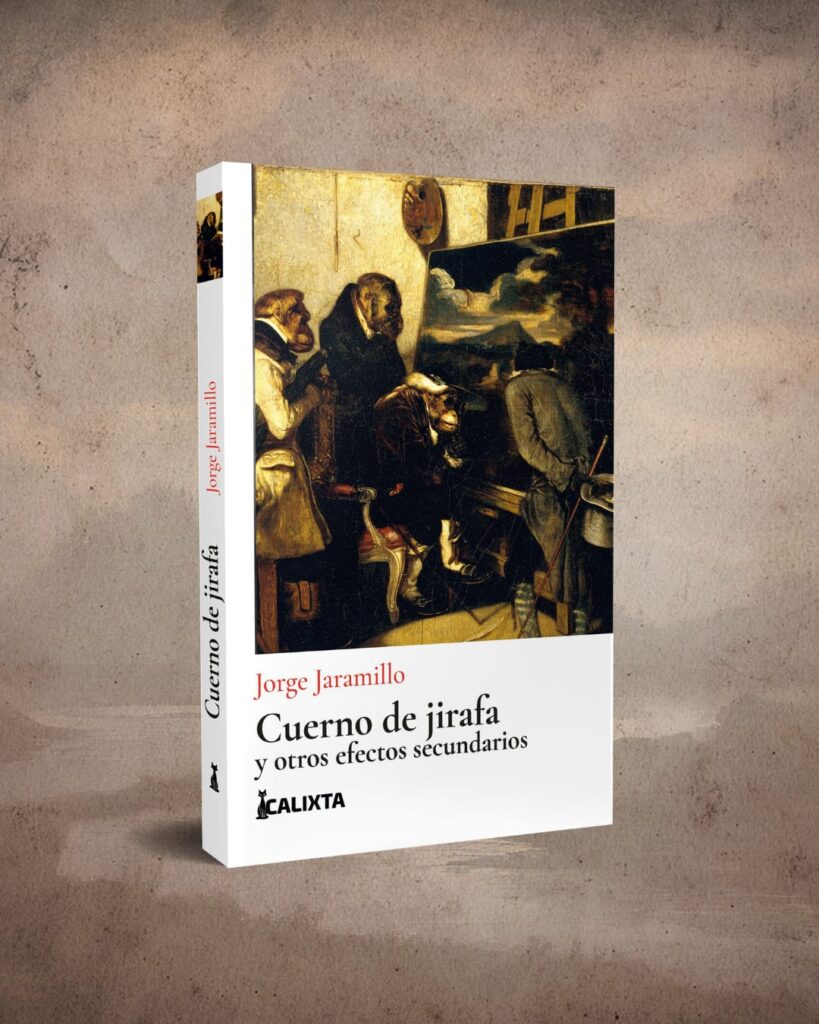
Cuerno de Jirafa y otros efectos secundarios
What starts as an ordinary day rarely ends that way